

The Victory Trap: How Momentum Dies
“Nothing murders momentum faster than a victory lunch.”
That’s what veteran sales trainer Tim Mulcahy preaches, and if you’ve been in the game for more than a week, you know he’s right. The script is universal:
You just closed a big deal. The rush is electric. You text the team, call your manager, and feel the earned right to coast. You drive to a favorite lunch spot, grab an early dinner, or scroll Instagram for an hour—all rationalized by the high of the win.
You just turned a multi-thousand dollar commission into a low-grade headache called the post-sale slump.
This blog is your antidote. Tim’s rules flip the switch from a one-and-done mentality to a repeatable stack and sprint system. You’ll get:
- Tim Mulcahy’s 7 Rules to kill the slump.
- Manager Cues to guide a rep’s next move.
- A printable field checklist to keep the streak alive.
The Classic Slump Patterns
The moment the deal is inked, a dangerous self-talk starts: “I earned a break.”
This is the internal justification for all the momentum killers:
- The Long Lunch: What started as a quick bite turns into 90 minutes of relaxing, killing the most productive part of the afternoon.
- The Early Quit: It’s 4:00 PM, and you hit quota. Why knock another door? You leave the field early, robbing yourself of the “golden hour” of selling.
- The Phone Scroll: You sink into the driver’s seat and mindlessly check texts, social media, or even worse, start processing paperwork you can do later.
Tim Mulcahy’s warnings are sharp and simple: these activities aren’t a break; they’re momentum killers. He stresses that celebration comes later, not now. Every minute you spend admiring the last deal is a minute you aren’t creating the next one.
The difference between a solid day and a life-changing streak often comes down to this 15-minute post-sale window.
“Most reps sell 1–2 deals and then feel like they can go home. The great ones sell 1–2 deals and realize they can sell 3, 4, or 5 deals because the energy is already there.”
Anecdote: We recently saw a rep close a tough deal at 5:30 PM. Instead of calling it a day, he decided to stick to the rule and knock five more doors on the same street before leaving. The result? He closed two additional deals that night simply by maintaining the energy of the first win. The extra two deals were pure profit from a state of momentum.
The 7 Rules to Beat the Slump
The key to beating the post-sale slump isn’t willpower; it’s a system. These 7 rules are Tim’s prescription for turning a successful sale into an unstoppable sprint.
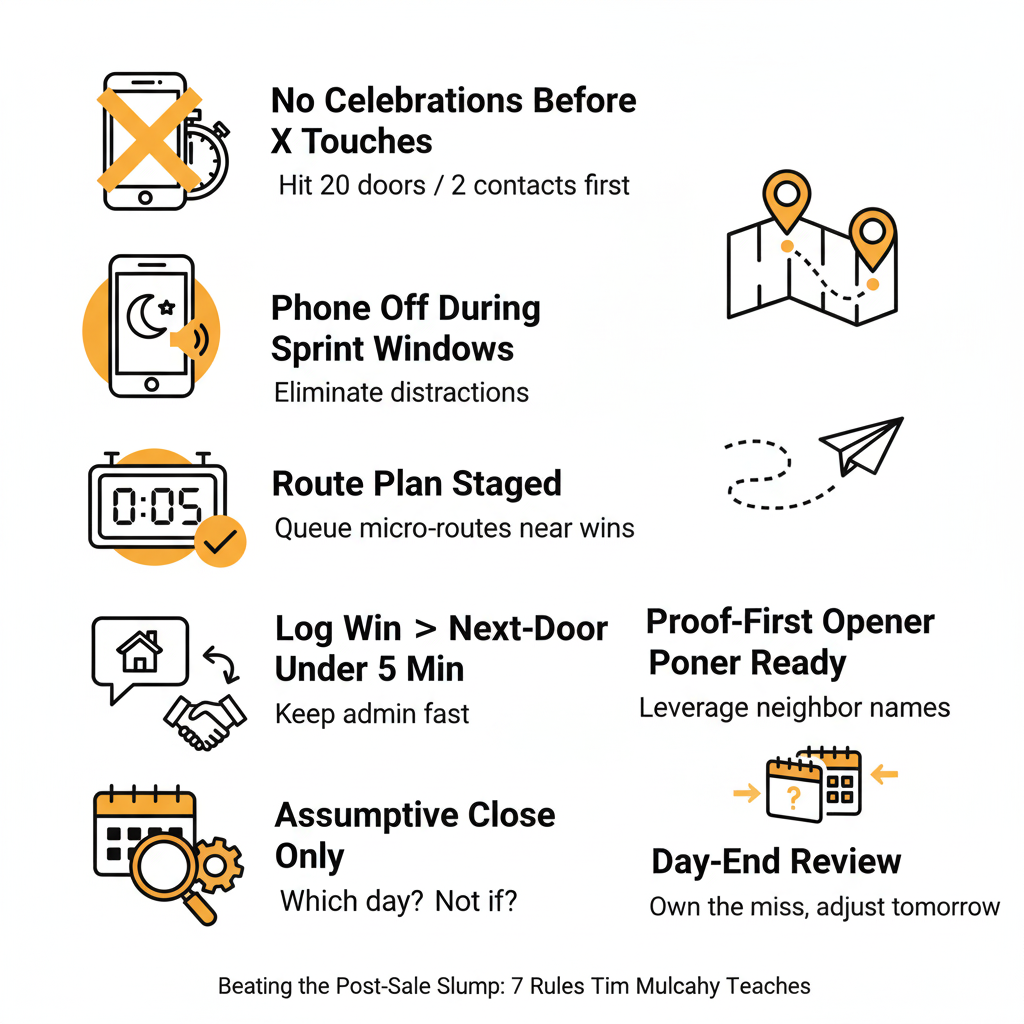
1. No Celebrations Before X Touches
A victory isn’t a cue to stop; it’s a cue to accelerate. Your first rule is to establish a non-negotiable minimum activity goal before you allow yourself any substantial celebration (lunch, driving home, etc.).
- Pick Your X: Tim suggests X be 20 doors knocked or two new quality contacts. You must hit this goal immediately following a close.
- Mini-Example: You close a deal. You immediately drive three houses down and knock doors until you hit your X requirement.
“If you want to celebrate, that’s fine. But first, you have to earn the next deal. Get back on the doors. Text the team after your next contact.”\
2. Phone Off During Sprint Windows
The fastest way to drain your ‘in-the-moment’ energy is to manage external communication. Your phone is a distraction, not a tool, during your high-activity sprint window.
- Rule: Silence the phone, put it face down, and do not pick it up for calls, texts, or logging until you complete your post-sale sprint goal (Rule 1).
- Manager Note: Managers should know not to call for a status report during this window—a text is fine, but a live conversation can break the rep’s focus.
- Mini-Example: The sale is done. You immediately drive to the next micro-route, phone on silent, and knock three houses before even logging the paperwork.
3. Route Plan Staged (Micro-Routes Queued Next to Wins)
Momentum dies when a rep has to stop and think about where to go next. Great reps already have their next move planned before the first sale is finished. This means micro-routes staged next to recent wins.
- The Power of Proximity: When you close a deal, you’re high-value to the neighbors. You are a local authority with social proof. Don’t lose that value by driving away.
- Rule: Your immediate next route is always the 10–20 houses surrounding the recent close. Have this area highlighted on your map before you drive to the field.
- Mini-Example: After closing on Elm St., you immediately have the next two blocks of Spruce St. pre-loaded as your target.
4. Log Win $\rightarrow$ Next-Door Under 5 Minutes
The administration of a deal—the logging, the paperwork, the internal reporting—is a necessary evil, but it cannot become a time sink that kills the afternoon.
- The 5-Minute Drill: Time yourself. From the moment the customer signs to the moment you are knocking the next door, you must not exceed five minutes. Do the bare minimum logging required to secure the sale, and do the rest after you’ve hit your Rule 1 targets.
- Mini-Example: Close the deal, take a quick photo of the signed contract, text “WIN” to the group, and walk to the next house. Full logging happens later.
“The money is made at the door, not in the driver’s seat. If you’re spending more than five minutes to log a deal, you’re robbing yourself of the next opportunity.”
5. Proof-First Opener Ready
You just closed a deal. Now, you’re an ambassador, not just a salesperson. Your pitch has changed. Use the recent win as your social proof opener for the immediate neighbors.
- Rule: Immediately incorporate the recent win into a powerful, proof-first opener. This opener is short, direct, and leverage-based.
- Openers to Use: “I was just next door helping your neighbor, the Johnsons, get started. I have their install scheduled for Tuesday—does Wednesday work better for you?”
- Mini-Example: “Hi, I’m [Your Name]. We’re getting [Neighbor’s Name] set up with the new [Product] right next door. Because I’m already out here, I can get you the same [Deal/Install time].”
6. Assumptive Close Only
Momentum allows you to shed fear and be decisive. The post-sale slump is avoided when you carry the decisiveness of the last win directly into your next pitch. This means aggressive, assumptive closing.
- Rule: Assume the sale. Use only when or which closes. Avoid if or maybe language. The next customer should feel that the sale is a certainty, not a decision.
- Assumptive Language: “Do you want to get this installed next week or the week after?” (Not: “Are you interested?”)
- Mini-Example: “Great. To lock in this pricing, I can fit you in with Mrs. Smith’s install on Tuesday morning, or are you a strictly afternoon person?”
7. Day-End Review (Own the Miss; Adjust Tomorrow)
A critical part of maintaining momentum is honestly reviewing the day, not just celebrating the win. This happens at the very end of the day—not in the field.
- Rule: Spend 5–10 minutes reviewing your day by yourself. Where did the momentum slow down? Did you hit your Rule 1 sprint goals? Own the miss but don’t dwell on it. Immediately assign yourself one actionable change for the morning.
- Mini-Example: “I missed my sprint goal by four doors. Tomorrow, I will leave the field 30 minutes earlier and stop the car at the first door, not the third.”
Ship Your Sprint Streak
Daily accountability beats willpower.
Manager Cues to Fuel the Sprint
A manager’s reaction to a closed deal is the biggest factor in whether a rep hits a slump or starts a streak. Your job is to acknowledge the win but immediately redirect the energy.
The Immediate Response (Under 60 Seconds)
When a rep calls or texts with a win, your reaction should be fast and directional:
- Quick Congrats: “Nice win! Great job on that close.”
- Immediate Direction: “Awesome. You have 90 minutes of pure sprint time. Hit the next 15 doors immediately. Report back by 7:00 PM with your activity and any new contacts.”
- Hold the Conversation: “We can talk about the details when you’re back at the office. Go get it!”
This does two things: it validates the rep while instantly establishing that the day isn’t over. It moves the finish line and ensures the energy is burned on the next deal, not a phone call.
Morning Meeting Momentum
Use the morning meeting not just for motivation but for accountability.
- Share Mini-Wins: Ask reps to share not just their deals, but their post-sale sprint activity. “Who hit their 20-door sprint after their first close yesterday?”
- Assign Sprints: Announce team-wide mini-sprints for the day. “The first person to close a deal today must immediately knock the next 15 doors on that street. Report that activity first.”
- This normalizes the sprint as the expected behavior after a win.
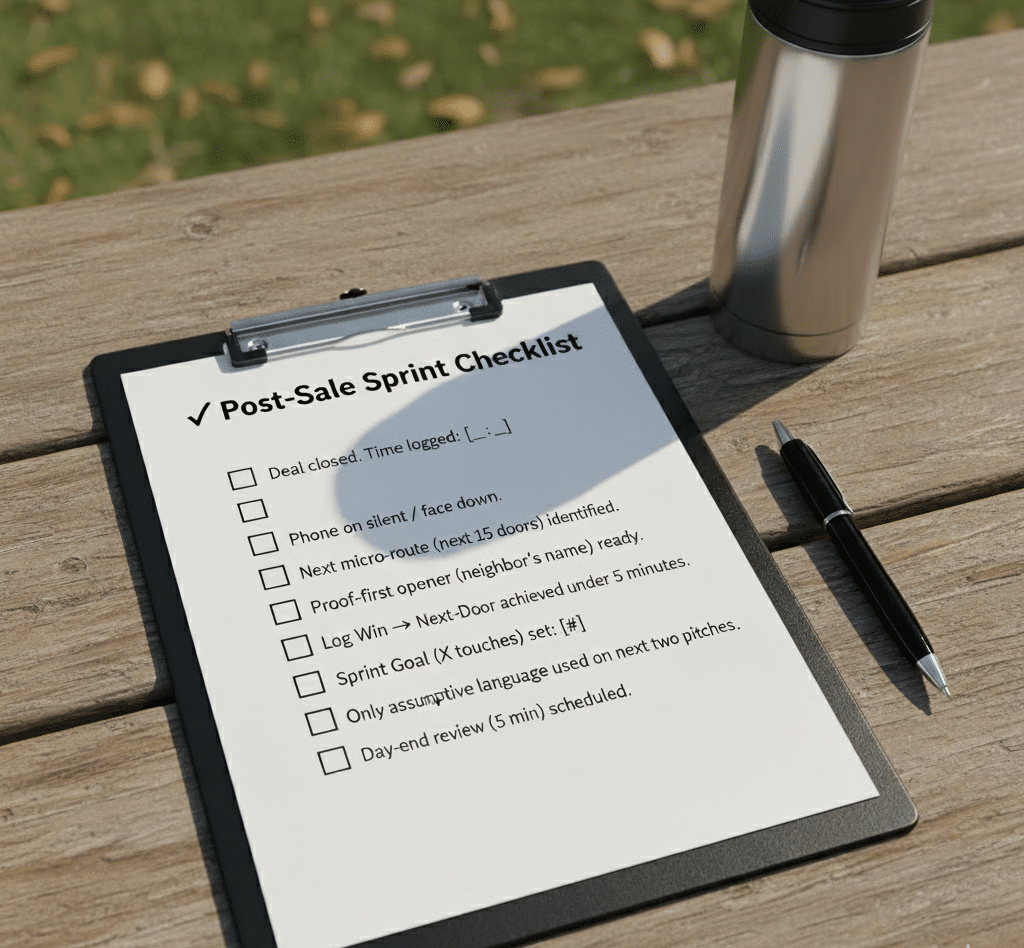
Field Checklist: Maintain Your Streak
Accountability is key. Keep this checklist handy—on your clipboard, laminated, or as a small screenshot on your phone—to internalize the post-sale sprint habit.
Final Thoughts: From Fatigue to Habit
The post-sale slump is a natural fatigue response—but it’s a habit you can reprogram. You aren’t replacing the need for rest; you’re simply re-timing the recovery.
By implementing Tim Mulcahy’s 7 rules, you stop losing the most valuable minutes of your day. You replace the slump with a sprint and use the high of a win to power the next opportunity.
It’s not about being relentlessly aggressive; it’s about being systematically effective. Normalize the sprint, and watch your stack of deals grow.
Frequently Asked Questions (FAQ)
Why do reps slump after a sale?
Reps slump after a sale primarily due to a natural psychological and physiological reaction called fatigue combined with the mental framing that they’ve “earned a break.” The brain seeks immediate reward (rest, food, social media) after completing a high-stress task, which, in the D2D environment, kills the momentum needed for the next deal.
Should managers force post-sale sprints?
Managers should not “force” a sprint, but they absolutely should expect and direct it. By making the post-sale sprint an established, non-negotiable step in the process (like Tim’s Rule 1), the manager normalizes it as part of the job, not a punishment. The focus should be on directional cues (“Go hit the next 15 doors”) rather than confrontational ones.
What number of “X calls” is realistic?
Tim Mulcahy’s recommendation for X is typically 20 doors knocked or securing 2 new quality contacts immediately following a closed deal. This number is realistic because the rep is already in a high-energy state and in a relevant location (right next to the win), making the activity highly efficient.
Is a quick celebration ever okay?
A quick, momentary celebration is okay, but it should be immediate and contained. A fist-pump, a quick text of “WIN” to the group, or a deep breath are fine. Any activity that requires driving away, logging in-depth, or spending more than five minutes stationary is a momentum killer and should be postponed until after the sprint goal is achieved.